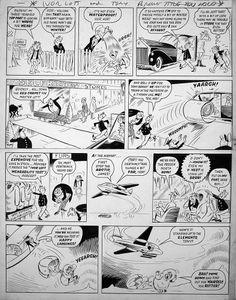
Ivor Lott & Tony Broke - North Pole (Original)
ParlettIvor11-12-71a
£190.00
Sub total
(You’ll pick your shipping method in the next step)
Proceed To Checkout
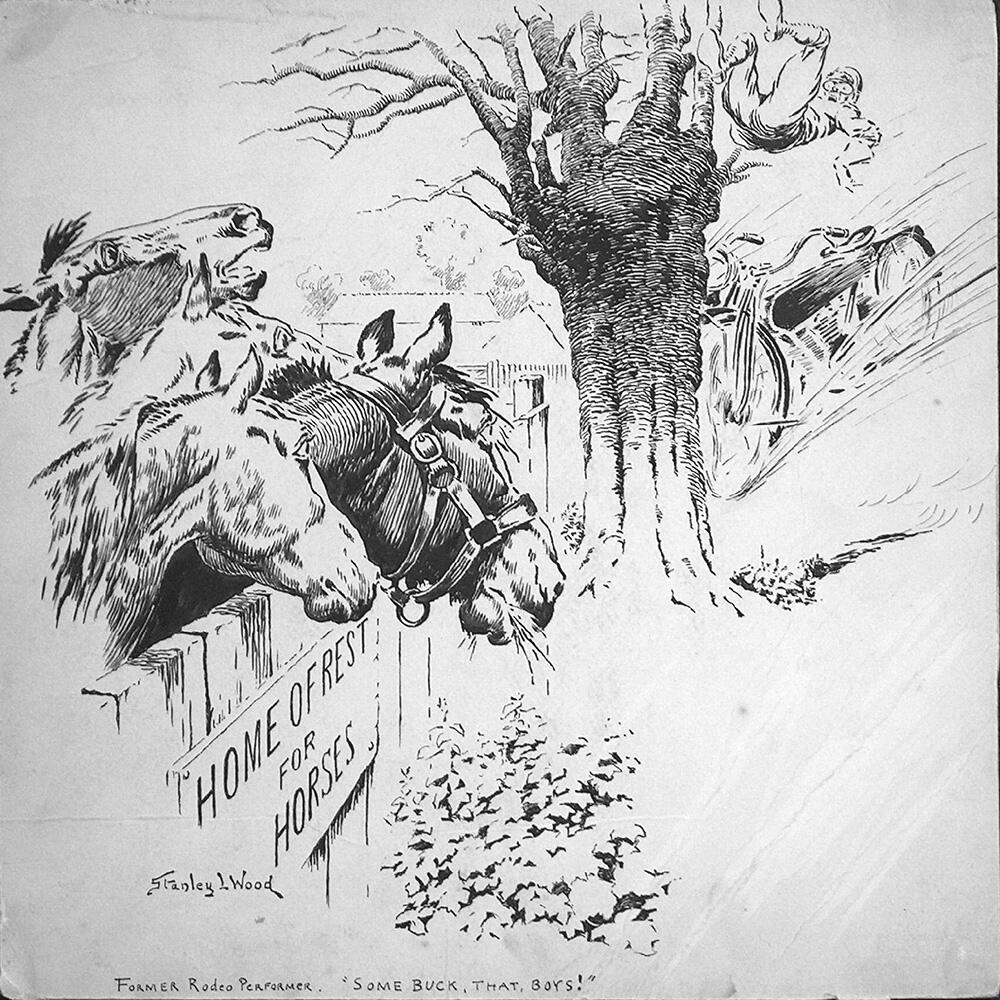
Stanley Llewellyn Wood (10 December 1867 - 1 March 1928; Newport, Monmouthshire, UK)
Stanley L. Wood was a hugely popular Welsh illustrator who contributed to magazines in the late 19th and early 20th centuries, chiefly remembered for his depictions of the wild west which graced many a boy's story paper.
It was the perfect match of subject and talent as Wood was superb at depicting horses in action; He spent some of his teen years in Kansas and he returned to America in 1888 when he was sent to South Dakota by The Illustrated London News. An authenticity infused his illustrations — whether a realistic painting or a cartoon — and his colour plates of the wild west in Boy's Own Paper and Chums have helped keep their respective annuals collectable.
Stanley Llewellyn Wood was born in Maindee, near Newport, Monmouthshire, in 1867, the son of Stanley James Wood, a cement manufacturer, and his wife Charlotte (nee Atkins). He grew up in Christchurch, Monmouthshire, and travelled with his family to America at the age of 12, where his father had bought a ranch in Indian territory in Kansas. Legend has it that the bodies of the former owners, who had been murdered by a raiding party of braves, were buried in the garden. Soon after James Stanley Wood's death, the house was surrounded by Ute Indians and, to scare them away, Charlotte had her children put on riding boots and spurs and they tramped up and down the stairs and from room to room, making as much noise as possible. The ruse worked and, believing the house to be heavily occupied, the natives retreated.
Charlotte and her family returned to St. Pancras, London and Wood went on to become a prolific illustrator of newspapers and magazines, including Black and White, Cassell's Magazine, The Graphic, The Harmsworth Magazine, The Idler, The London Magazine, The Pall Mall Magazine, Pearson's Magazine, The Penny Magazine, The Sporting and Dramatic News, The Strand Magazine, Wide World Magazine, The Windsor Magazine and Young England. Wood's magazine and book illustrations included works by Cutcliffe Hyne (Captain Kettle), Dr. Nokola by Guy Boothby and Don Q. by Hesketh Pritchard. As a painter he also exhibited at the Royal Academy.
Kirkpatrick states that Wood's first illustration work was The Tales of The Spanish Boccaccio: Count Lucanor: Or the Fifty Pleasant Stories of Patronio translated by James York from the original by Prince Don Juan Manuel published in 1888 by Pickering & Chatto. The illustration of this book, as on some others he did, was attributed to S. L. Wood, rather than Stanley L. Wood.
His next book was The Arabian Nights Entertainments "Aldine" Edition, from the text Of Dr. Jonathan Scott. This consisted of four large 600 page volumes. It was also published by Pickering & Chatto and cost 24 shillings (one pound and four shillings). The Times said that "With one or two possible exceptions, the illustrations are fair in themselves and unimpeachable in treatment".
Wood's first two books were for Pickering & Chatto which Andrew Chatto (1841–1913) owned, but Chatto moved the publishing work to Chatto & Windus. Houfe notes that Wood was "employed almost continuously by Messrs Chatto's as an illustrator of boys' adventure stories". The Illustrated London News sent Wood to South Dakota in 1888 where he was able to build on his juvenile experience of the American Old West way of life and for many years produced work with a cowboy and Indian flavour. Harper's published a number of his illustrations, and his Sketches from an Indian Reservation appeared in the Illustrated London News of 19 January 1889.
In 1890 he produced sixty pen and ink illustrations for Bret Harte A Waif of the Plains. His illustrations often appeared in early issues of Pearson's Magazine and covered a wide range of genres; notably, he illustrated George Griffith's Stories of Other Worlds (January–July 1900), early science fiction.
His many Africana illustrations included those for the books of Bertram Mitford (1855–1914) - The Gun Runner (1893), The Luck of Gerald Ridgeley (1894), The Curse of Clement Wayneflete (1894), Renshaw Fanning's Quest (1894), The King's Assegai (1894), A Veldt Official (1895) and The Expiation of Wynne Palisser (1896).
In 1900, he did 100 illustrations for an American edition of Richard Burton's The Book of the Thousand Nights and a Night. Presumably he was awarded this work because of his earlier work on Crellin's Romances of the Old Seraglio.
His illustrations of the Anglo-Boer War appeared in Black & White and Black & White Budget. Most of these featured equestrian scenes. Some of these illustrations also appeared in L'Illustré Soleil du Dimanche and one appeared as a cover illustration for War Pictures. He worked for War Illustrated during World War I.
The book-dealer and founding member of the Potomac Corral, Jefferson Chenoweth Dykes better known as Jeff Dykes (-1989), wrote in Fifty Great Western Illustrators - "No better horse artist ever lived than Stanley L. Wood - there was more action in a Stanley Wood illustration than in the story itself".
Wood married Mary Elizabeth Jenkins in Fulham on 21 February 1899. They had three children: Stanley Montague, Henry Lawrence and Jack Steward. The family lived in Palmers Green, Middlesex, where Wood died on 1 March 1928, aged 61. He had been ill for some weeks and, although he could not raise himself from his bed unaided, insisted that he continue working on his final illustration – for a 'Kettle' story – with his wife and son supporting him.
Source: Illustration Art Gallery; Steve Holland; Wikipedia
See STANLEY L WOOD ART ('page not found' if no art currently listed).
Stanley L Wood biography
