
Richard Caton Woodville Jr biography
Richard Caton Woodville Jr biography
Richard Caton Woodville Jr (7 January 1856 - 17 August 1927; London, UK)
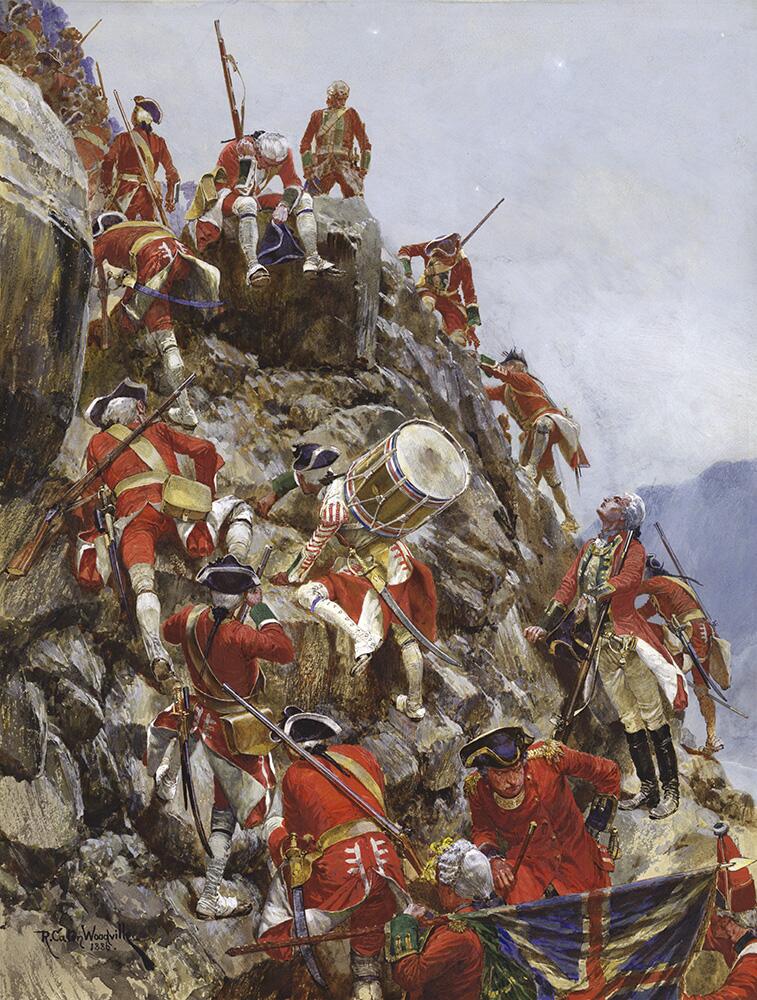
Richard Caton Woodville Jr was a widely recognised and prolific artist, producing many accomplished illustrations and paintings, notably for the Illustrated London News. He is particularly remembered for his battle scenes and many of his paintings are in military art collections, such as the National Army Museum, the Royal Naval College, the Royal Canadian Military Institute, the London Scottish Regiments Museum Trust and West Point, as well as national collections such as the Tate Gallery.
He was the son of Richard Caton Woodville Sr (1825-1855) an American artist and the son of a stockbroker, who originally studied medicine but who turned to painting as a career. In 1845, at the age of 20, Caton Woodville Sr left Baltimore to train at the Kunstacademie in Düsseldorf, Germany, where he lived for the next six years with his wife, Mary Theresa (née Buckler), whom he had married on 3 January 1844. Richard Caton Woodville Sr died of an overdose of morphine in London at the age of 30, the year before his son Jr was born.
In 1879, Richard Caton Woodville Jr's painting Before Leuthen, Dec. 3rd, 1757 was exhibited at The Royal Academy and, over the next few years he produced many popular paintings, amongst them Kandahar and Saving the Guns at Maiwand (both inspired by the Second Anglo-Afghan War), and many scenes from the Zulu War and First Boer War. His painting The Moonlight Charge at Kassassin was exhibited at The Fine Art Society in 1883 and The Guards at Tel-e-Kebir was exhibited by Royal Command in 1884. The latter was painted for the Royal Family in 1882 and led to a number of further commissions, including the wedding of Princess Beatrice to Prince Henry of Battenberg in 1885. He later also painted portraits of King Edward VII and King George V.
Woodville was commissioned by the Illustrated London News to paint a series depicting famous battle throughout history, including The Charge of the Light Brigade, The Charge of the 21st Lancers at Omdurman, The Battle of Blenheim, The Battle of Badajos and several of The Battle of Waterloo. In 1895 he produced some 200 drawings, 2 large paintings and 2 smaller paintings. He maintained a large collection of arms and uniforms at his studio.
He married Annie Elizabeth Hill in 1877 and had twin sons, actor Anthony Caton Woodville and painter William Passenham Caton Woodville, in 1884. His wife sued him for divorce in 1892. In spite of his success, Caton Woodville suffered financial problems, and was declared bankrupt in 1905.
He continued to paint scenes of battle, and few battles or wars that Great Britain fought during his life were not touched upon by him, including the Second Boer War, and World War I. Despite his precocious talent for capturing the dramatic moments of contemporary battles, Woodville also enjoyed recreating historical scenes in both oil and watercolour.
The Illustrated London News commissioned him to complete a commemorative special series recreating the most famous British battles of history. He depicted The Charge of the Light Brigade (Palacio Real de Madrid) and The Charge of the 21st Lancers at Omdurman (Walker Art Gallery), Battle of Blenheim, Battle of Badajos and several Battle of Waterloo pictures.
During World War I, Woodville was compelled to return to the depiction of current events, and three of his Great War works were displayed in the Royal Academy. These were The 2nd Batt. Manchester Regiment taking six guns at dawn near St. Quentin, Entry of the 5th Lancers into Mons, and Halloween, 1914: Stand of the London Scottish on Messines Ridge (London Scottish Regiment Museum Trust) exhibited in the year of his death, 1927.
During his lifetime, Woodville enjoyed great popularity and was considered amongst the best artists of his genre. He wrote as well as painted, and was often the subject of magazine and journal articles. He had a deep passion for the British Army and had even joined the Berkshire Yeomanry in 1879, staying with them until 1914 when he joined the National Reserve as a captain.
Woodville lived at Flat B, Dudley Mansions, 29 Abbey Road, St John's Wood, Middlesex, where he committed suicide on 17 August 1927: at shortly after 1 pm, Woodville's housekeeper and a friend, Mr. P. Gair, heard a report from a revolver and found Woodville sitting in his favourite chair in the studio attached to his house with a bullet wound to his head. He was still breathing, but died on the way to the hospital. Although he had been laughing and joking only that morning, Woodville had recently been suffering from heart trouble and pain from his leg, which he had broken years earlier and which had been aggravated by a second accident in Egypt.
After such an active life, Woodville was worried that, at 71, he would become an invalid. A letter read out at an inquest on 20 August 1927 revealed his final thoughts: "I am mentally and bodily ill. My health is a thing of the past." The Coroner recorded a verdict that Woodville was of unsound mind when he shot himself.
Source: Illustration Art Gallery; Wikipedia
See RICHARD CATON WOODVILLE JR ART.
Send this to a friend
Richard Caton Woodville Jr biography