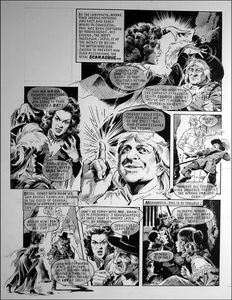
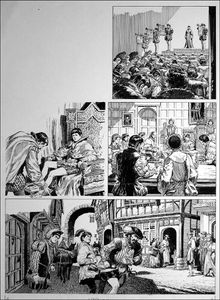
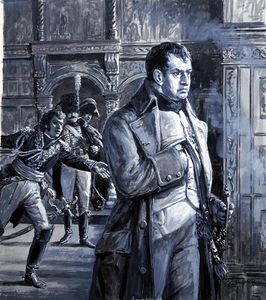
Arrival of the Ice Queen (Original)
MendozaTSausage
£620.00
Sub total
(You’ll pick your shipping method in the next step)
Proceed To Checkout

Artist: Philip Mendoza
Medium: Gouache on Board
Size: 6" x 9" (145mm x 225mm)
Date: 1958
Code: MendozaGGWW12
This is the unique original Gouache painting by Philip Mendoza.
This is a single panel original painting by Philip Mendoza featuring the wonderful Gulliver Guinea-Pig. The adventures, which were written by David Roberts, see Gulliver travelling the world, meeting all kinds of people and having adventures that are gentle and feature slightly wry humour best appreciated by adults.
In this story Gulliver visits the Wild West. Originally painted for the pre-school comic Playhour in 1958, the artwork has been remounted and extra work created to make it fit the larger format of the Jack and Jill Storybooks which were printed in the early 1960s. Gulliver was reprinted at least three issues of that series, dating from 1962.
Montague Philip Mendoza (14 October 1898 - 1973 (active 1948-1970); born Dalston, London, UK)
Born in Hackney, London, Philip Mendoza was a mid-20th century British comic artist, illustrator and political cartoonist who sometimes worked under the pseudonyms Flam or Flambo. His father was a clerk of Spanish-Jewish descent who became the Keeper of the Jew's Burial Ground in Mile End, London. He was active as a painter and sculptor too. The Mendoza family moved to Tynemouth, Northumberland, but also lived in France, South America and Bournemouth. When Mendoza was 14 years old he became a pavement artist.
He was a descendant of the great bare-knuckle pugilist of the Regency days, Daniel Mendoza, and was, by all accounts, a most colourful character in every meaning of the word.
He was dark and swarthy and usually wore a bright-hued neckerchief, which added to his gypsy-like appearance.
He created newspaper comics like The Man You'd Like to Kick during the 1910s and in 1942 he was the first comic artist to create a biographical comic about Winston Churchill. Mendoza created various adventure comics for Pendulum Publications and the Amalgamated Press. He is best remembered as the artist of various nursery rhyme comics such as Princess Petal (1956-1959), Gulliver Guinea-Pig (1958-1965), Katie Country Mouse (1959-1964) and Winifred and Stephanie (1969-1972).
During the inter-war years, Mendoza was active as a painter in the London area. One of his paintings received the honor of being exhibited at the Royal Academy in 1939. He also made a name for himself as a political cartoonist who signed his work with the name "Flambo". During the 1920s, cartoons by Flambo appeared in magazines like The Miner, the official weekly paper of the Miners' Federation of Great Britain. Among Mendoza's illustrated political books were 'Bullets for Baldwinism. Points against the Tory government from "the New Leader"' (1929) and 'Hail, Hitler! The Nazi Speaks to the World' (1934).
During the 1940s he illustrated a number of books, including Biggles Charter Pilot (1943), and a great many paperback covers of all genres (signing his work under many aliases, including Gomez, Ferrari, Garcia, Grimaldi and Zero) before turning to comics.
One of his greatest achievements occurred early on in his career: The Mighty Atom (1948), an all colour comic strip, designed and drawn in its entirety by Mendoza. This publication, from the tiny firm of Denlee Publishing Co., can probably lay claim to being the first all-colour, all picture, British comic. It certainly shows Mendoza's versatility, containing as it does strips featuring highwaymen, cowboys, detectives, space-travellers and funnies. It was written and published by the author/publisher, Stephen Frances, for whom he later designed the silhouette logo of Hank Janson for the famous series of "hard-boiled" paperback thrillers.
Mendoza drew the comic Captain Vigour for Miller's Sports Cartoons series before starting work for the Amalgamated Press where he drew strips for Sun, Comet, Cowboy Comics Library, Super Detective Library and, during its early years, for Thriller Comics Library; first contributing a number of short strips, in issues 4 and 6, and then the splendidly drawn Ali Baba and the Forty Thieves (number 7).
His ability to capture a brooding atmosphere was admirably displayed in The Green Archer (no.16) and Phantom Footsteps (no. 20, for which he also contributed the cover painting) and his Rogues' Moon (no.66) is an entertaining piratical adventure.
His one piece of work for the Super Detective Library: The Island of Fu Manchu (no. 9) is generally accepted as one of the best issues of the series. Mendoza was a true professional who would turn his hand to almost any style of strip. During the latter part of his career, a great deal of his output was for the nursery comics. His version of Kenneth Graham's Wind in the Willows was published in book form, in full colour, by Leonard Matthews' Martspress.
By 1963 Mendoza illustrated various classic children's novels for the weekly educational children's magazine Treasure. The same publication also ran the comic strip 'Tufty', which taught young readers about safety precautions. Between 1966 and 1967 a short-lived childrens' magazine called TV Toyland came out, featuring mostly comics and stories based on popular British children's TV series. Mendoza drew 'All At Sea' ("with Captain Ruff and the jolly crew of the Mathilda") and 'Rolf Harris and Coojibear' for this publication, the latter based on 'The Rolf Harris Show' (1967-1974). TV Toyland merged with Playhour in 1967, where 'All At Sea' continued. In 1969 Mendoza could already be found in a new nursery rhyme magazine, Once Upon A Time, where he illustrated another text comic about cute little female mice from the countryside and the city, 'Winifred and Stephanie' (1969-1972). The stories, like nearly all content in Once Upon A Time, were written by Barbara Matthews.
During the final years of his life, Philip Mendoza suffered from alcoholism. This made him miss his deadlines and occasionally leave his artwork unfinished. His editor was sometimes forced to send someone to his house to pick up the drawings. At the office other artists had to draw panel borders and complete the rest of the illustrations in order to have it printed. Philip Mendoza passed away in 1973.
Source: David Ashford and Norman Wright; Illustration Art Gallery
Gulliver Goes West 12 (Original)